|
Our research is focused on molecular and supramolecular structures that facilitate communication between neurons at the chemical synapse and how such structures are perturbed in neurological disease. We are particularly interested in the architectural arrangement of signaling molecules and enzymes, and characterizing the ways in which such molecular assemblies are formed and undergo changes during synaptic transmission and modulation. Our approach is to investigate individual proteins using x-ray and electron crystallographic methods and to combine this information with EM images obtained via 3-D reconstruction of supramolecular assemblies and tomographic analysis of the intact chemical synapse. Our long-term goal is to construct a dynamic molecular and architectural map for the chemical synapse that will help to understand synaptic formation, transmission and plasticity.
Ion channel structure and mechanism. Several ion channels are being studied with the plan of determining the molecular mechanism of their action. These include voltage gated channels responsible for propagation and termination of action potentials, calcium channels involved in signal amplification and ligand gated ion channels involved in signal detection and modulation. Using rapid affinity purification methods, along with x-ray crystallography and electron microscopy, our goal is to elucidate the structural elements of these channels in various state.
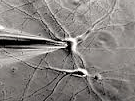
Synaptic architecture, dynamics, and plasticity. Using electron tomographic methods we have begun to study the architecture of the chemical synapse in cultured neurons. Our first goal is to establish the common architectural elements present at the synapse and to identify the molecules involved using specific antibody labeling or genetic tagging. Subsequently, we will perform field potential stimulations coupled with cryogenic trapping to investigate the dynamic processes involved in synaptic transmission. Ultimately we plan to study long-term, stimulation dependent, synaptic changes in the hopes of gaining insight into the architectural elements underlying synaptic plasticity.
Alzheimer's Disease. Using a variety of methods we are investigating the early stages of neurodegeneration in Alzheimer's disease. In particular we are interested in the interaction of beta-amyloid peptides with synaptophysin and the synaptophysin/synaptobrevin complex. Synaptophysin is the earliest protein degraded during Alzheimer's disease yet its role both in synaptic transmission and in Alzheimer's remains elusive. Using biochemical and biophysical methods we have discovered that beta-amyloid peptides disrupt the synaptophysin/synaptobrevin complex which results in proteolytic degredation of synaptophysin.
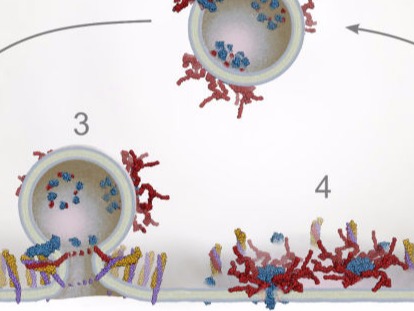
Formation and mechanisms of supramolecular assemblies. Supramolecular organization and assembly of biomolecules occurs throughout biology. We are interested in supramolecular protein assemblies such as the channel clustering proteins rapsyn and PSD95, the self assembling GTPase dynamin, as well as the viral coat protein of tobacco mosaic virus. The interests and goals of these projects are twofold. First, to understand the role of supramolecular organization and assembly in maintaining and modulating synaptic transmission. And second, the potential of such biomolecular systems to serve as templates for nanomolecular assembly and patterning of materials.
SUPPORT:
CLICK TO VISIT
The Beckman Foundation,
The Human Frontier Science Program,
The Howard Hughes Medical Institute,
The Agouron Institute, The SIE Foundation,
National Science Foundation,
National Institutes of Health,
DARPA, Synkera, ClariMedix, AstraZeneca,
Bioptix, and
The University of Colorado.
PUBLICATIONS: CLICK TO DOWNLOAD PDF.
Arthur, C.P.
and Stowell, M.H.B. (2007). Structure
of synaptophysin: A hexameric MARVEL domain channel protein,
Structure, 15, 707-714.
Arthur,
C. P., Serrell, D. B., Pagratis, M., Potter, D. L., Finch, D. S., and
Stowell, M. H. B. (2007) Electron tomographic methods for studying the
chemical synapse, Cellular Electron Microscopy . 79,
241-257.
Brian A.
Larsen, Michael A. Haag, Michael H. B. Stowell, David C. Walther, Albert P.
Pisano, and Conrad R. Stoldt (2007). Controlling nanoparticle aggregation
in colloidal microwave absorbers via interface chemistry. Proc. SPIE
6525, 652519.
D.
Routkevitch, O. Polyakov and M. Stowell, (2006) Micromachined Ceramic
Platform for Living Neuronal Networks, Electrochem. Soc. 601,
1265.
Yeh, A.P.,
McMillan, A. and Stowell, M.H.B. (2006) Rapid and simple
protein-stability screens: application to membrane proteins, Acta
Crystallogr D Biol Crystallogr. 62:451-7.
Tierney, M.L.,
K.E. Osborn, P.J. Milburn, Stowell, M.H.B, and S.M. Howitt. (2004).
Phylogenetic conservation of disulfide-linked, dimeric acetylcholine
receptor pentamers in southern ocean electric rays, J Exp Biol.
207:3581-90.
Demir,
M and Stowell, M.H.B. (2002) A chemoselective biomolecular template
for assembling diverse nanotubular materials, Nanotechnology
13:541-544.
Marks,
B., M.H., Stowell, Y.
Vallis,
I.G. Mills, A. Gibson, C.R. Hopkins, and H.T. McMahon (2001)
GTPase activity of
dynamin and
resulting conformational change are essential for
endocytosis,
Nature 410:231-235. |